

Rail and tube strikes confirmed as talks fail BBC
UK rail strike - Britain faces biggest rail strike in 30 years The Sun
Rail and tube strikes to go ahead next week, RMT union confirms The Guardian
The public wants firm action on union chaos The Telegraph
Rail and Tube strikes WILL go ahead as last-ditch talks fail Daily Mail
Rail and tube strikes confirmed as talks fail
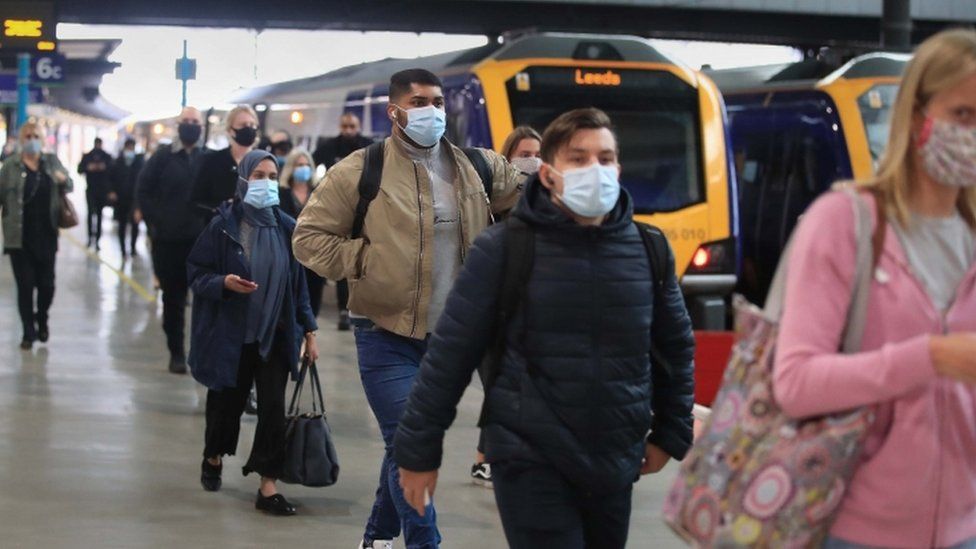 IMAGE SOURCE,PA MEDIA
Rail and tube strikes will go ahead next week after talks failed to resolve a row over pay, jobs and conditions, union leaders have confirmed.
The Rail, Maritime and Transport union (RMT) said discussions with Network Rail, train operators and London Underground had failed.
The strike will cause disruption across England, Scotland and Wales.
The Department for Transport said it was disappointing and that strikes should "always be the last resort".
The action, which will involve thousands of workers, will take place across 13 train operators and Network Rail on Tuesday, Thursday and next Saturday, and there will be a London Underground strike on Tuesday.
Operators have said there will be knock-on effects on other days as well.
Network Rail, which owns and maintains the country's railways, said the union was "dismissing talks before we've even finished" with more discussions planned for Sunday.
A Network Rail spokesperson said it was "serious" about trying to find a solution and a compromise which gave people a "decent pay rise", but was also affordable for taxpayers and farepayers.
Mick Lynch, the RMT's general secretary, told BBC Radio 4's Broadcasting House programme the latest offer from Network Rail was for a 2% pay increase, with a possible extra 1% if "productivity" conditions involving job cuts are accepted.
"We won't be bought off on that principle. We cannot have our members' lives disrupted in the way they are proposing," he said.
He added that he would support a so-called general strike if one were achievable.
"Working people in this country are fed up with low pay and precarious work as well as having decent conditions under threat," he said.
In a recent Q and A for members, the RMT said its position in all pay negotiations was for an above Retail Price Index (RPI) inflation pay rise.
RPI, a measure of inflation used to calculate the cost of living, was 11.1% as of April 2022 - up from 2.9% a year earlier. The union said it had recently secured an 8.4% rise workers on the London Underground.
As to whether pay rises should be backdated to compensate for pay freezes, the union said any rise "should reflect that members have not had a pay rise... and the drastic increase in the cost of living".
The RMT says there are proposals to cut 2,500 maintenance jobs on Network Rail, which the union claims could "increase the possibility of trains flying off the tracks".
Network Rail says it would never consider changes that make the railway or its people less safe.
'No one wins'
Meanwhile, passengers have been warned by Network Rail not to travel on trains unless necessary during strikes next week, with about half of all rail lines closed.
A skeleton timetable on strike days will see about 20% of services running. For example, the last direct train from Edinburgh to London on Tuesday, the first day of the strike, departs at 12:30 according to the latest timetable from LNER.
The Rail Delivery Group said that "no one wins in the event of a strike" and said it would be working alongside Network Rail to keep as many services running as possible.
The group's chair Steve Montgomery said this week that taxpayers have supported the rail industry with "the equivalent of about £600 per household since Covid" adding that "passenger numbers are still only at around 75% of pre-pandemic levels".
A Department for Transport spokesperson said the government had committed £16bn to keeping the railways running during the pandemic, but warned the industry was still "on life support" and strikes could stop customers choosing rail travel in the future.
Labour leader Sir Keir Starmer he wanted all parties around the negotiating table "even at this late hour" as he did not want the strikes to go ahead.
"But, like the British public, I'm frustrated because the government is sitting it out, it's not lifting a finger to resolve these strikes," he said.

Rail and tube strikes to go ahead next week, RMT union confirms
Strikes on railways confirmed for Tuesday, Thursday and Saturday, and on tube network on Tuesday
Which trains will be running where and when?
Anna MacSwanSat 18 Jun 2022 09.44 BST
Britain’s biggest rail strike in more than 30 years will begin next Tuesday, causing almost a week of disruption to train services.
The Rail, Maritime and Transport workers’ union (RMT) confirmed on Saturday that talks have failed to resolve a bitter row over pay, jobs and conditions, meaning that strike action will go ahead.
Three 24-hour strikes at Network Rail and 13 train operators are planned on Tuesday, Thursday and Saturday, as well as on London Underground on Tuesday. About 40,000 workers are expected to take part.
Despite discussions over the past few weeks with senior representatives from Network Rail, train operators and London Underground, the RMT says it has not been able to reach a “viable” settlement.
Its general secretary, Mick Lynch, said: “Despite the best efforts of our negotiators, no viable settlements to the disputes have been created.”
“It has to be restated that the source of these disputes is the decision by the Tory government to cut £4bn of funding from our transport systems – £2bn from national rail and £2bn from Transport for London.
“As a result of this transport austerity imposed by the government, the employing companies have taken decisions to savage the railway pension scheme and the Transport for London scheme, cutting benefits, making staff work longer, and poorer in retirement, while paying increased contributions.”
Sign up to First Edition, our free daily newsletter – every weekday morning at 7am BST
A special timetable will be in operation from 20 to 26 June. Several operators have already warned passengers not to attempt to travel on strike days.
Lynch added that thousands of jobs were being cut across the rail networks and that workers faced below-inflation pay rises.
“In the face of this massive attack on our people, the RMT cannot be passive,” he said. “So today, having heard the reports on the discussions that have been taking place, we are confirming that the strike action scheduled to take place on 21, 23 and 25 June will go ahead.
“We want a transport system that operates for the benefit of the people, for the needs of society and our environment – not for private profit. We call on the entire labour movement and the working people to rally to the support of the RMT and our members in this struggle.”
A Rail Delivery Group spokesperson said: “No one wins in the event of a strike. The action next week will affect the millions of people who use the train each day, including key workers, students with exams, those who cannot work from home, holidaymakers and people attending important business and leisure events.
“Working with Network Rail, our plan is to keep as many services running as possible, but significant disruption will be inevitable and some parts of the network will not have a service, so passengers should plan their journeys carefully and check their train times.”
The Department for Transport said it was “hugely disappointing” that the strikes were going ahead. A spokesperson said: “The government committed £16bn to keep our railways running throughout the pandemic while ensuring not a single worker lost their job. The railway is still on life support, with passenger numbers 25% down, and anything that drives away even more of them risks killing services and jobs.
“Train travel for millions more people is now a choice, not a necessity. Strikes stop our customers choosing rail, and they might never return.
“We urge the RMT to reconsider so we can find a solution that delivers for workers, passengers and taxpayers alike.”
A Network Rail spokesperson said: “Yet again the RMT union is dismissing talks before we’ve even finished, with more planned for tomorrow.
“We’re serious about trying to find a solution and work out a compromise that gives our people a decent pay rise, but it has to be affordable for taxpayers and farepayers.”
Network Rail said it would continue to try to find a way to avert the strike.
Rail and Tube strikes WILL go ahead as last-ditch talks fail while Treasury warns giving in to strikers' pay demands will boost spiralling inflationThe Rail, Maritime and Transport (RMT) Union strike demanding pay rises for workers is set to go ahead
The Union also claims Network Rail plans to cut jobs and reduce spending – with impact on customer safety
Ahead of the main strikes, on Tuesday, Thursday and Saturday, operators have warned customers not to travel
Operators have warned of significantly reduced services, while some have cancelled services all together
It comes as the treasury warned that giving into strikers pay demands could further increase inflation in UK
Next week's rail and Tube strikes are set to go ahead after talks failed to resolve a row over pay, jobs and working conditions, the Rail, Maritime and Transport union has announced.
The RMT Union has demanded inflation-tied pay rises for workers and a guarantee of no compulsory redundancies as part of a national drive to save more than £2bn across Britain's railway network.
Underpinning the calls for industrial action are also claims that train operators have endured years of pay freezes and changes to their terms and conditions.
The union also claims Network Rail plans to cut jobs and reduce spending –with an impact on safety. But Network Rail and the Government have accused the union of an unwillingness to modernise work practices.
General secretary Mick Lynch said: 'Despite the best efforts of our negotiators no viable settlements to the disputes have been created.'
He confirmed that strikes at Network Rail and 13 train operators will go ahead on Tuesday, Thursday and next Saturday, and on London Underground on Tuesday.
'It has to be restated that the source of these disputes is the decision by the Tory Government to cut £4bn of funding from our transport systems - £2bn from national rail and £2bn from Transport for London,' he said.
'As a result of this transport austerity imposed by the Government, the employing companies have taken decisions to savage the Railway Pension Scheme and the Transport for London scheme, cutting benefits, making staff work longer, and poorer in retirement, while paying increased contributions.
'In the face of this massive attack on our people the RMT cannot be passive.
'So today, having heard the reports on the discussions that have been taking place we are confirming that the strike action scheduled to take place on 21st, 23rd and 25th June will go ahead.
'We want a transport system that operates for the benefit of the people, for the needs of society and our environment - not for private profit.
'We call on the entire labour movement and the working people to rally to the support of the RMT and our members in this struggle.'
A spokesperson for Rail Delivery Group added: 'No one wins in the event of a strike.
'The action next week will affect the millions of people who use the train each day, including key workers, students with exams, those who cannot work from home, holidaymakers and people attending important business and leisure events.
'Working with Network Rail, our plan is to keep as many services running as possible, but significant disruption will be inevitable and some parts of the network will not have a service, so passengers should plan their journeys carefully and check their train times.'
It comes as the Treasury warned against giving into strikers demands amid fears that pay increases would fuel inflation.
Simon Clarke, chief secretary to the Treasury, has said 'unrealistic expectations around pay' would worsen the inflation crisis.
Inflation is currently at a 40-year high. Earlier this week, the Bank of England was forced to increase its inflation prediction for the year to 11 per cent.
'We have to be very careful at this point about preventing inflation from becoming a self-fulfilling prophecy,' Mr Clarke said.
Rail passengers give mixed opinions on the planned RMT strike

'And this is what the Chancellor and I are obviously very keenly focused on in the Treasury, that we want to make sure that everyone understands that we need to help people with the cost of living, and that some of the answer to that is pay.
'But what we can't do is have unrealistic expectations around pay, which do in turn prolong and intensify this inflation problem because we all want it to end. And the way it will end soonest is if we are sensible about pay.'
There are concerns that next week's strike will now encourage other unions to take action, which could increase inflation further and put pressure on public sector budgets.
The Bank of England's chief economist warned that it may be forced to raise interest rates by half a percentage point for the first time since gaining independence in 1997 if inflation rises.
RMT Union John Leach can't deny the prospect of a General Strike
'If we see greater evidence that the current high level of inflation is becoming embedded in pricing behaviour by firms, in wage-setting behaviour by firms and workers, then that will be the trigger for this more aggressive action,' Huw Pill told Bloomberg TV.
The situation could worsen still as staff on one Britain's busiest railways the TSSA - serving 640,000 commuters in London and Kent each day - have also threatened to walk out next month.
The ballot could see workers at Southeastern, which is owned by the Department for Transport (DfT), go on strike as early as July 25 if successful.
The TSSA said its workers were 'seeking basic fair treatment in the teeth of a crippling cost of living crisis', but rail operators have called on unions to 'talk, not walk' as the dispute which is set to cause chaos this summer rumbles on.
Separate strikes will also be held involving the Associated Society of Locomotive Engineers and Firemen (ASLEF) union, on the Croydon Tramlink, while the RMT and Unite will also strike on June 21 on the London Underground.
The strike will hit average hardworking and already-pressed Britons hardest, with thousands of train journeys and dozens of lines set to be closed on Tuesday, Thursday and Saturday next week.
A planned strike by drivers on Hull Trains has since been called off following talks over a pay dispute.
Members of Aslef were due to walk out on June 26.
The company said in a statement: 'Following the latest round of talks on Friday, we are pleased to announce that we have reached an agreement with Aslef to call off their planned strike action on Sunday June 26 and to continue meaningful talks.
'We are keen to reach an agreement that is acceptable to both sides and further talks will be arranged shortly.'
UK rail strike - Britain faces biggest rail strike in 30 years The Sun
Rail and tube strikes to go ahead next week, RMT union confirms The Guardian
The public wants firm action on union chaos The Telegraph
Rail and Tube strikes WILL go ahead as last-ditch talks fail Daily Mail
Rail and tube strikes confirmed as talks fail
IMAGE SOURCE,PA MEDIARail and tube strikes will go ahead next week after talks failed to resolve a row over pay, jobs and conditions, union leaders have confirmed.
The Rail, Maritime and Transport union (RMT) said discussions with Network Rail, train operators and London Underground had failed.
The strike will cause disruption across England, Scotland and Wales.
The Department for Transport said it was disappointing and that strikes should "always be the last resort".
The action, which will involve thousands of workers, will take place across 13 train operators and Network Rail on Tuesday, Thursday and next Saturday, and there will be a London Underground strike on Tuesday.
Operators have said there will be knock-on effects on other days as well.
Network Rail, which owns and maintains the country's railways, said the union was "dismissing talks before we've even finished" with more discussions planned for Sunday.
A Network Rail spokesperson said it was "serious" about trying to find a solution and a compromise which gave people a "decent pay rise", but was also affordable for taxpayers and farepayers.
Mick Lynch, the RMT's general secretary, told BBC Radio 4's Broadcasting House programme the latest offer from Network Rail was for a 2% pay increase, with a possible extra 1% if "productivity" conditions involving job cuts are accepted.
"We won't be bought off on that principle. We cannot have our members' lives disrupted in the way they are proposing," he said.
He added that he would support a so-called general strike if one were achievable.
"Working people in this country are fed up with low pay and precarious work as well as having decent conditions under threat," he said.
In a recent Q and A for members, the RMT said its position in all pay negotiations was for an above Retail Price Index (RPI) inflation pay rise.
RPI, a measure of inflation used to calculate the cost of living, was 11.1% as of April 2022 - up from 2.9% a year earlier. The union said it had recently secured an 8.4% rise workers on the London Underground.
As to whether pay rises should be backdated to compensate for pay freezes, the union said any rise "should reflect that members have not had a pay rise... and the drastic increase in the cost of living".
The RMT says there are proposals to cut 2,500 maintenance jobs on Network Rail, which the union claims could "increase the possibility of trains flying off the tracks".
Network Rail says it would never consider changes that make the railway or its people less safe.
'No one wins'
Meanwhile, passengers have been warned by Network Rail not to travel on trains unless necessary during strikes next week, with about half of all rail lines closed.
A skeleton timetable on strike days will see about 20% of services running. For example, the last direct train from Edinburgh to London on Tuesday, the first day of the strike, departs at 12:30 according to the latest timetable from LNER.
The Rail Delivery Group said that "no one wins in the event of a strike" and said it would be working alongside Network Rail to keep as many services running as possible.
The group's chair Steve Montgomery said this week that taxpayers have supported the rail industry with "the equivalent of about £600 per household since Covid" adding that "passenger numbers are still only at around 75% of pre-pandemic levels".
A Department for Transport spokesperson said the government had committed £16bn to keeping the railways running during the pandemic, but warned the industry was still "on life support" and strikes could stop customers choosing rail travel in the future.
Labour leader Sir Keir Starmer he wanted all parties around the negotiating table "even at this late hour" as he did not want the strikes to go ahead.
"But, like the British public, I'm frustrated because the government is sitting it out, it's not lifting a finger to resolve these strikes," he said.
Rail and tube strikes to go ahead next week, RMT union confirms
Strikes on railways confirmed for Tuesday, Thursday and Saturday, and on tube network on Tuesday
Which trains will be running where and when?
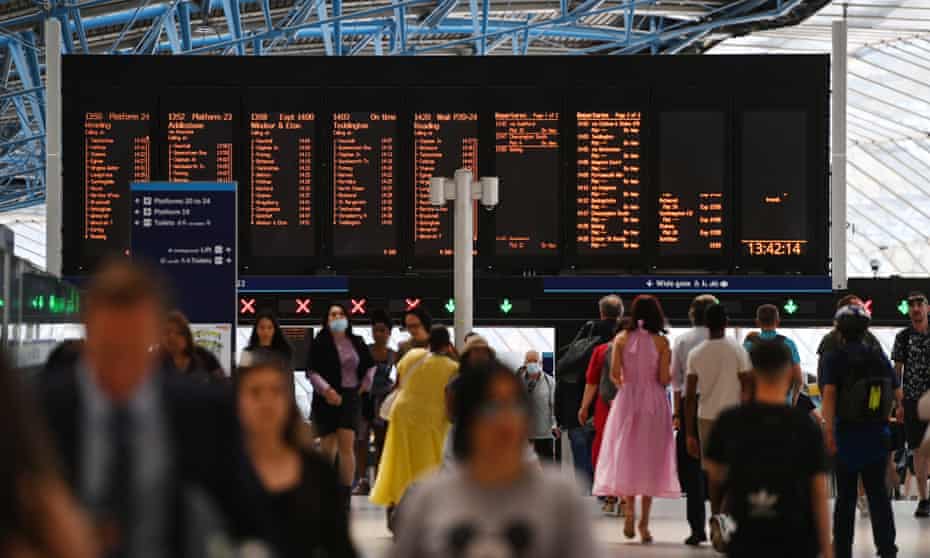 |
| A special timetable will be in operation from 20 to 26 June. Several operators have already told passengers not to attempt to travel on strike days. Photograph: Andy Rain/EPA |
Anna MacSwanSat 18 Jun 2022 09.44 BST
Britain’s biggest rail strike in more than 30 years will begin next Tuesday, causing almost a week of disruption to train services.
The Rail, Maritime and Transport workers’ union (RMT) confirmed on Saturday that talks have failed to resolve a bitter row over pay, jobs and conditions, meaning that strike action will go ahead.
Three 24-hour strikes at Network Rail and 13 train operators are planned on Tuesday, Thursday and Saturday, as well as on London Underground on Tuesday. About 40,000 workers are expected to take part.
Despite discussions over the past few weeks with senior representatives from Network Rail, train operators and London Underground, the RMT says it has not been able to reach a “viable” settlement.
Its general secretary, Mick Lynch, said: “Despite the best efforts of our negotiators, no viable settlements to the disputes have been created.”
“It has to be restated that the source of these disputes is the decision by the Tory government to cut £4bn of funding from our transport systems – £2bn from national rail and £2bn from Transport for London.
“As a result of this transport austerity imposed by the government, the employing companies have taken decisions to savage the railway pension scheme and the Transport for London scheme, cutting benefits, making staff work longer, and poorer in retirement, while paying increased contributions.”
Sign up to First Edition, our free daily newsletter – every weekday morning at 7am BST
A special timetable will be in operation from 20 to 26 June. Several operators have already warned passengers not to attempt to travel on strike days.
Lynch added that thousands of jobs were being cut across the rail networks and that workers faced below-inflation pay rises.
“In the face of this massive attack on our people, the RMT cannot be passive,” he said. “So today, having heard the reports on the discussions that have been taking place, we are confirming that the strike action scheduled to take place on 21, 23 and 25 June will go ahead.
“We want a transport system that operates for the benefit of the people, for the needs of society and our environment – not for private profit. We call on the entire labour movement and the working people to rally to the support of the RMT and our members in this struggle.”
A Rail Delivery Group spokesperson said: “No one wins in the event of a strike. The action next week will affect the millions of people who use the train each day, including key workers, students with exams, those who cannot work from home, holidaymakers and people attending important business and leisure events.
“Working with Network Rail, our plan is to keep as many services running as possible, but significant disruption will be inevitable and some parts of the network will not have a service, so passengers should plan their journeys carefully and check their train times.”
The Department for Transport said it was “hugely disappointing” that the strikes were going ahead. A spokesperson said: “The government committed £16bn to keep our railways running throughout the pandemic while ensuring not a single worker lost their job. The railway is still on life support, with passenger numbers 25% down, and anything that drives away even more of them risks killing services and jobs.
“Train travel for millions more people is now a choice, not a necessity. Strikes stop our customers choosing rail, and they might never return.
“We urge the RMT to reconsider so we can find a solution that delivers for workers, passengers and taxpayers alike.”
A Network Rail spokesperson said: “Yet again the RMT union is dismissing talks before we’ve even finished, with more planned for tomorrow.
“We’re serious about trying to find a solution and work out a compromise that gives our people a decent pay rise, but it has to be affordable for taxpayers and farepayers.”
Network Rail said it would continue to try to find a way to avert the strike.
Rail and Tube strikes WILL go ahead as last-ditch talks fail while Treasury warns giving in to strikers' pay demands will boost spiralling inflationThe Rail, Maritime and Transport (RMT) Union strike demanding pay rises for workers is set to go ahead
The Union also claims Network Rail plans to cut jobs and reduce spending – with impact on customer safety
Ahead of the main strikes, on Tuesday, Thursday and Saturday, operators have warned customers not to travel
Operators have warned of significantly reduced services, while some have cancelled services all together
It comes as the treasury warned that giving into strikers pay demands could further increase inflation in UK
Next week's rail and Tube strikes are set to go ahead after talks failed to resolve a row over pay, jobs and working conditions, the Rail, Maritime and Transport union has announced.
The RMT Union has demanded inflation-tied pay rises for workers and a guarantee of no compulsory redundancies as part of a national drive to save more than £2bn across Britain's railway network.
Underpinning the calls for industrial action are also claims that train operators have endured years of pay freezes and changes to their terms and conditions.
The union also claims Network Rail plans to cut jobs and reduce spending –with an impact on safety. But Network Rail and the Government have accused the union of an unwillingness to modernise work practices.
General secretary Mick Lynch said: 'Despite the best efforts of our negotiators no viable settlements to the disputes have been created.'
He confirmed that strikes at Network Rail and 13 train operators will go ahead on Tuesday, Thursday and next Saturday, and on London Underground on Tuesday.
'It has to be restated that the source of these disputes is the decision by the Tory Government to cut £4bn of funding from our transport systems - £2bn from national rail and £2bn from Transport for London,' he said.
'As a result of this transport austerity imposed by the Government, the employing companies have taken decisions to savage the Railway Pension Scheme and the Transport for London scheme, cutting benefits, making staff work longer, and poorer in retirement, while paying increased contributions.
'In the face of this massive attack on our people the RMT cannot be passive.
'So today, having heard the reports on the discussions that have been taking place we are confirming that the strike action scheduled to take place on 21st, 23rd and 25th June will go ahead.
'We want a transport system that operates for the benefit of the people, for the needs of society and our environment - not for private profit.
'We call on the entire labour movement and the working people to rally to the support of the RMT and our members in this struggle.'
A spokesperson for Rail Delivery Group added: 'No one wins in the event of a strike.
'The action next week will affect the millions of people who use the train each day, including key workers, students with exams, those who cannot work from home, holidaymakers and people attending important business and leisure events.
'Working with Network Rail, our plan is to keep as many services running as possible, but significant disruption will be inevitable and some parts of the network will not have a service, so passengers should plan their journeys carefully and check their train times.'
It comes as the Treasury warned against giving into strikers demands amid fears that pay increases would fuel inflation.
Simon Clarke, chief secretary to the Treasury, has said 'unrealistic expectations around pay' would worsen the inflation crisis.
Inflation is currently at a 40-year high. Earlier this week, the Bank of England was forced to increase its inflation prediction for the year to 11 per cent.
'We have to be very careful at this point about preventing inflation from becoming a self-fulfilling prophecy,' Mr Clarke said.
Rail passengers give mixed opinions on the planned RMT strike
'And this is what the Chancellor and I are obviously very keenly focused on in the Treasury, that we want to make sure that everyone understands that we need to help people with the cost of living, and that some of the answer to that is pay.
'But what we can't do is have unrealistic expectations around pay, which do in turn prolong and intensify this inflation problem because we all want it to end. And the way it will end soonest is if we are sensible about pay.'
There are concerns that next week's strike will now encourage other unions to take action, which could increase inflation further and put pressure on public sector budgets.
The Bank of England's chief economist warned that it may be forced to raise interest rates by half a percentage point for the first time since gaining independence in 1997 if inflation rises.
RMT Union John Leach can't deny the prospect of a General Strike
'If we see greater evidence that the current high level of inflation is becoming embedded in pricing behaviour by firms, in wage-setting behaviour by firms and workers, then that will be the trigger for this more aggressive action,' Huw Pill told Bloomberg TV.
The situation could worsen still as staff on one Britain's busiest railways the TSSA - serving 640,000 commuters in London and Kent each day - have also threatened to walk out next month.
The ballot could see workers at Southeastern, which is owned by the Department for Transport (DfT), go on strike as early as July 25 if successful.
The TSSA said its workers were 'seeking basic fair treatment in the teeth of a crippling cost of living crisis', but rail operators have called on unions to 'talk, not walk' as the dispute which is set to cause chaos this summer rumbles on.
Separate strikes will also be held involving the Associated Society of Locomotive Engineers and Firemen (ASLEF) union, on the Croydon Tramlink, while the RMT and Unite will also strike on June 21 on the London Underground.
The strike will hit average hardworking and already-pressed Britons hardest, with thousands of train journeys and dozens of lines set to be closed on Tuesday, Thursday and Saturday next week.
A planned strike by drivers on Hull Trains has since been called off following talks over a pay dispute.
Members of Aslef were due to walk out on June 26.
The company said in a statement: 'Following the latest round of talks on Friday, we are pleased to announce that we have reached an agreement with Aslef to call off their planned strike action on Sunday June 26 and to continue meaningful talks.
'We are keen to reach an agreement that is acceptable to both sides and further talks will be arranged shortly.'
Labour leader Sir Keir Starmer has reiterated that the Labour Party 'does not want these strikes to go ahead'.
'I want all the parties around the negotiating table, even at this late hour, to resolve this,' he said.
'But, like the British public, I'm frustrated because the Government is sitting it out, it's not lifting a finger to resolve these strikes.'
Here, in one easy to look at place, MailOnline breaks down the delays and closures on each of the major rail networks next week.
Sir Keir Starmer does not back strikes but insists the PM does
Nguồn bài viết Du học Đồng Thịnh | (+84) 96 993.7773 | (+84) 96 1660.266 | (+44) 020 753 800 87 | info@dongthinh.co.uk
'I want all the parties around the negotiating table, even at this late hour, to resolve this,' he said.
'But, like the British public, I'm frustrated because the Government is sitting it out, it's not lifting a finger to resolve these strikes.'
Here, in one easy to look at place, MailOnline breaks down the delays and closures on each of the major rail networks next week.
Sir Keir Starmer does not back strikes but insists the PM does
Nguồn bài viết Du học Đồng Thịnh | (+84) 96 993.7773 | (+84) 96 1660.266 | (+44) 020 753 800 87 | info@dongthinh.co.uk

Đăng nhận xét