

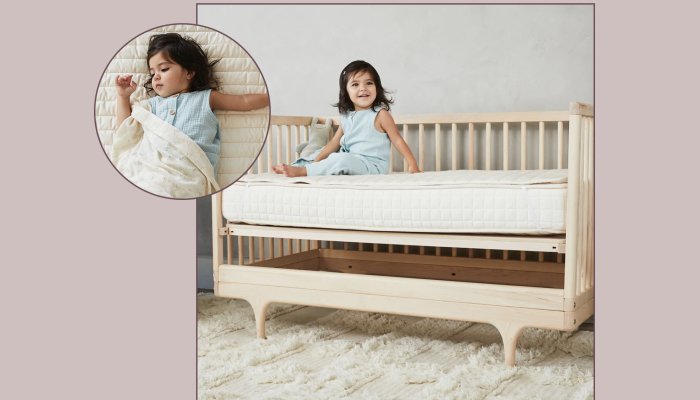
Breath easy about your baby's sleep.
While tons of brands label their products as nontoxic, it's a pretty vague statement without the proper certifications. Luckily, there's a few hacks for finding the best nontoxic crib mattresses. Tasha Stoiber, Ph.D., a senior scientist at EWG, suggests looking for a company that values transparency to start your shopping process, calling it one of the "most important things" a parent can do. She explains that if a company is transparent about the materials it uses and how they're sourced, "Then you know exactly what you are getting and can avoid harmful materials."
Below, find more expert advice on what certifications to look for in a crib mattress (and which materials to avoid)—plus, shop our picks for the best nontoxic crib mattresses of 2022.
A peek at the best nontoxic crib mattresses of 2022:
What is a nontoxic crib mattress?
As the name implies, a nontoxic crib mattress poses a low risk of releasing toxins. In particular, this centers around off-gassing, a common scenario in which manufactured items slowly release volatile organic compounds (VOCs) into the environment as they air out over time. VOCs are often created during the manufacturing process and can be formed in the foams, fabrics, or plastics used in many standard mattresses.
In truth, most items in your home release VOCs, including electronics, clothing, carpeting, furniture, wall paint, and appliances. That said, inhaling elevated levels of VOCs can be particularly irritating for some—namely young infants or people with compromised respiratory systems, or known chemical allergies.
"Volatile organic compounds are harmful to both short-term and long-term health," Stoiber explains. "In the short term, they can be linked to respiratory irritation and increased asthma symptoms. In the long term, they are linked to more serious health harms, such as cancer. They are more common in mattresses made with polyurethane foam."
The importance of nontoxic certifications.
Nontoxic certifications are provided by third-party oversight organizations that test the brand's products to confirm that the VOCs being emitted are low enough to not pose a risk of encouraging respiratory complications or allergies. The most common certifications for mattresses are GREENGUARD, CertiPUR-US, and GOTS.
A mattress may carry more than one certification, especially given that some oversight agencies only focus on one or a few select materials. For example, it's common to see brands featuring both CertiPUR-US and GOTS certifications. CertiPUR-US reviews the foam, and GOTS checks other materials such as a mattress' cotton cover—so if a product uses both foam and cotton, it's important to have the two stamps of approval.
To that point, Stoiber advises to "Make sure that the whole mattress is certified and not just one part, like the cover." She also notes that CertiPUR-US on its own is not particularly meaningful, as "It actually doesn't provide much protection beyond what is already required by law."
Types of nontoxic certifications:
GREENGUARD
GREENGUARD is the certification organization managed by Underwriters Laboratories (UL) and is considered the most rigorous. UL has some of the strictest testing standards across all products and requires the lowest VOC emission limits for all materials present in mattresses submitted for review.
CertiPUR-US
CertiPUR-US is a certification focusing specifically on polyurethane foam VOC emissions, making this certification important for foam and memory foam mattresses. This organization also reviews emissions for flame retardants, formaldehyde, phthalates, mercury, lead, other heavy metals, and other VOCs. But again, Stoiber explains that this certification on its own does not hold much significance.
GOTS
GOTS grants organic and low-chemical processing certification for textiles. To achieve the GOTS Certified Organic label, the fabric content for a product must be made from 95% organic fibers. Additionally, during the production process, the manufacturer must adhere to strict guidelines regarding the types of chemicals used (e.g., dyes, processing agents, etc.) and may not use harsh chemicals, such as formaldehyde, genetically modified organics (GMOs), or toxic heavy metals.
How we picked:
When it comes to ensuring your mattress is nontoxic, certifications are crucial. We've made sure each of the mattresses we selected boasts substantial certifications.
We spoke with experts to determine what to look for in a nontoxic crib mattress and took this insight into account when choosing these mattresses.
Since everyone's budget is different, we included nontoxic crib mattresses at a variety of price points while being careful not to sacrifice quality.
We took customer feedback seriously when selecting these products and chose mattresses with primarily positive reviews while calling out any major negative comments.

Đăng nhận xét