

- Live Train strikes latest: 'Public is behind us' claims RMT as millions forced to work from home The Telegraph
- Train strike: Home working up as rail services grind to a halt BBC
- Second day of rail strikes start after talks collapse in acrimony The Guardian
- This is what the voters of Tiverton think of the rail strikes The Independent
- The Tories have resorted to sharing misleading information over rail strikes The Independent
- View Full coverage on Google News
Train strikes dates: What dates in June and July are they and will I be affected?
Rail unions held their second mass walkout, and further strikes are planned for Saturday and in July
ByHelen Cahill and Hannah Boland24 June 2022 • 2:20am
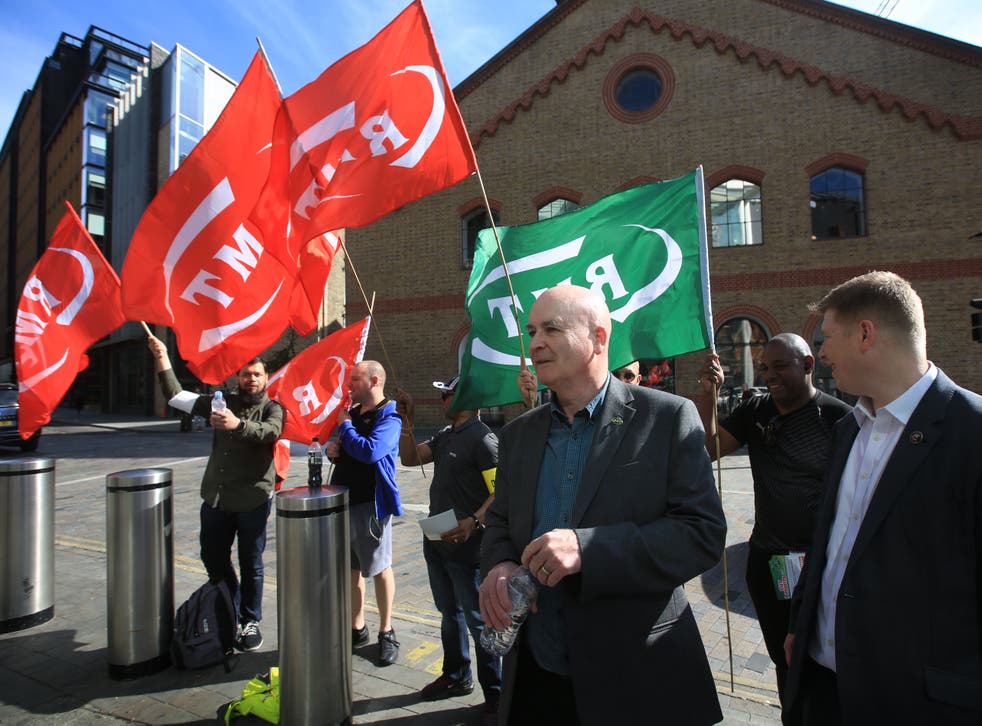
 RMT workers are walking out in a dispute over pay and jobs CREDIT: Guy Smallman/Getty
The second day of the biggest rail strike in a generation went ahead after last-ditch talks failed to reach agreement.
Another strike is planned this week as passengers brace for more travel chaos.
Entire towns and cities are to be cut off from the train network as strike action closes half of Britain's rail lines.
Huge swathes of Britain will be without any rail services on Saturday, as 40,000 RMT members walk out for the third time in a week in a dispute over pay and jobs.
Commuters are being told not to travel by train as the entire network is crippled by the largest strike in more than 30 years.
Tens of thousands of rail workers are walking out in what has been described as the "biggest outbreak of industrial action in the UK since 1989". The Rail, Maritime and Transport union announced it had organised a separate strike on the railways.
Union bosses claimed that they would "shut down the system", with the major disruption expected to impact events including Glastonbury Festival and the British Athletics Championships.
When is the next train strike happening?Saturday June 25
As many as 40,000 workers on railway services will strike again on Saturday, June 25, according to the RMT union. Walk-outs took place on on Tuesday, 21 June and Thursday, 23 June with as many as 50,000 railway workers on strike and services across Network Rail and the London Underground affected.
Union bosses said the action was due to affect rail services "for the entire week where the three days of action have been called". This is because trains may not be at the right stations after the walk-outs take place.
Rail union TSSA union is balloting Network Rail staff later this month for strike action that could start on Monday, July 25 – around the time of the Commonwealth Games in Birmingham.
TSSA General Secretary Manuel Cortes said: “We could be seeing a summer of discontent across our railways if Network Rail don’t see sense and come to the table to face the concerns of their staff.
“Fat cat bosses have so far refused these completely reasonable requests, leaving us with no option other than to ballot for industrial action, something which is always a last resort.”
Which rail operators will be affected?
Only a fifth of mainline rail services are expected to be running over the three-day strike period in June. Rail operators have published revised timetables for the strike week. The rail services disrupted are:Chiltern Railways
Cross Country Trains
Greater Anglia
LNER
East Midlands Railway
c2c
Northern Trains
South Eastern
South Western Railway
Great Western Railway
TransPennine Express
Avanti West Coast
West Midlands Trains
TSSA's action with Network Rail would have a broader impact on services. It has members in engineering, maintenance, supervisory, control and management roles.
What are workers striking over?
Rail workers have voted to strike after a row with Network Rail over pay freezes and proposed job cuts. RMT claims that as many as 2,500 jobs are at risk and that workers have been subject to years of pay freezes.
TSSA is demanding no compulsory redundancies for 2022, no changes to terms and conditions unless they are agreed with staff, and pay increases that keep up with inflation.
RMT General Secretary Mike Lynch said of the action: "We have a cost-of-living crisis, and it is unacceptable for railway workers to either lose their jobs or face another year of a pay freeze."
National Rail has responded by saying the union "must recognise we are a public body and any pay increase has to be affordable for taxpayers".
Chief executive Andrew Haines said: "We cannot expect to take more than our fair share of public funds, and so we must modernise our industry to put it on a sound financial footing for the future. Failure to modernise will only lead to industry decline and more job losses in the long run."
Is there a Tube strike today?The 24-hour strike on the London Underground, which began on Tuesday, 21 June, ended on Wednesday, 8am.
Saturday's strike will affect Elizabeth line and London Overground services, and trains will be affected until mid-morning on Sunday, TfL said.
Tuesday's Tube strike was part of a row over how Transport for London is cutting its running costs – something TfL says the Government has ordered it to do to achieve financial sustainability on its operations by April 2023.
TfL says its latest proposals to make savings mean "no changes to pensions and nobody has or will lose their job as a result of the proposals we have set out". Instead TfL has suggested that it does not fill between 500 and 600 posts as they become vacant.
Can I get a refund or travel on another service if my train is cancelled?
National Rail says passengers who bought tickets in advance but who will no longer be travelling because a service has been cancelled, delayed or rescheduled "may be entitled to a fee-free refund or change from the original retailer of your ticket".
However, it is not that simple. According to consumer group Which?, the process differs based on which train company someone is travelling with, and customers can "only claim compensation during a rail strike for a delay based on the replacement or emergency timetable for train or replacement bus services".
It says passengers may only be eligible for a refund if they try an alternative service offered by the operator and that service is delayed. How long they have to be delayed to get this refund is different based on which rail company people are travelling on.
National Rail has said passengers may be able to travel on other providers and other ticket restrictions may be lifted for those travelling on affected services. This includes potentially travelling the day before or up to two days after strike action ends.
National Rail says it will not pay hotel or taxi bills if customers have already booked those before the strike action was announced and are no longer able to get to their destination.
This article is kept updated with the latest information.
BBCPlay video Rail strike 'devastating' for hotel business from BBC
What happened today?Thanks for joining our live coverage of the day's events. We're closing our coverage shortly, but here's a recap of what happened:British Airways workers based at Heathrow voted in favour of strikes in a dispute over pay
A No 10 spokesman says the government expects BA to put in place contingency measures to ensure little disruption is caused
Train services have been disrupted across Britain on the second day of rail strikes, with another walkout planned for SaturdayGlastonbury festival-goers who decided to travel by train despite the strike were surprised to find a lack of queues at London stations
Plans are under way to change the law to enable employers to use agency staff to cover staffing gaps during strikes
Scotland's first minister Nicola Sturgeon has called on the UK government to get around the table with the RMT union
Today's reporting was brought to you by Victoria Lindrea, Adam Durbin, Craig Hutchison, Marita Moloney, James Harness, Alexandra Fouche, Lauren Hirst and Aoife Walsh.
It was edited by Chris Giles, Jeremy Gahagan and Holly Wallis.
Article share tools
ShareView more share options
Share this post
Copy this linkRead more about these links.
This is going to be a difficult summer for British Airways.
IT problems and staff shortages have already hit its operations this year. Now you can add industrial action to the mix.
Check-in staff at Heathrow are set to walk out during the summer peak. The airline will have contingency plans in place, but with systems already under strain, disruption seems inevitable.
The airline insists that it wants to work with staff, and that it’s 10% one-off bonus offer was a prelude to meaningful pay talks. It is still under pressure, too – the industry has not fully recovered.
But the problem its facing is that when the cuts were first imposed, many staff were deeply upset by what they saw as the heavy-handed approach of the airline’s management.
And now, it’s pretty clear that many workers simply don’t trust the word of their managers.
Posted at 23:42 23 Jun23:42 23 Jun
Train services are expected to be disrupted tomorrow

PA MediaCopyright: PA Media
Although railway staff are on strike today the effect of the industrial action will still be felt tomorrow.
It's thought only 60% of the normal weekday services will operate. This is due to the knock-on effect of overnight signallers and control room staff being on strike.
Trains will leave depots a lot later in the morning than usual when the daytime shift starts work at around 06:00. Normally, trains are moved from 03:00.
The length of time it takes for train services to get back to normal depends on the distance between a depot and a station. In a major city trains do not have so far to travel, but for rural areas it may take several hours.
However, it's not just Friday morning when there will be disruption. Some train operators will wind-down services slightly earlier than normal, ahead of the next planned strike on Saturday.
Passengers are urged to check for amendments to train companies' timetables.
Article share tools
ShareView more share options
Share this post
Copy this linkRead more about these links.
Posted at 23:36 23 Jun23:36 23 Jun
‘I commute to work by kayaking down a Welsh river’
WILLIAM LAILEY / CATERS NEWS AGENCYCopyright: WILLIAM LAILEY / CATERS NEWS AGENCY
Rail strikes have been causing disruption across much of the UK this week, with people struggling to get to work.
But for one commuter, the walkouts were never going to be an issue.
George Bullard has been kayaking to the office since 2015, a mode of transport he chose because it was "an interesting way to get to work".
He travels to his workplace in Presteigne in Wales, where he runs a camping company, by kayaking down the River Lugg, when it's safe to do so.
But he warns against others following suit, saying it can be dangerous without the right experience.
Read more here.
Article share tools
ShareView more share options
Share this post
Copy this linkRead more about these links.
Posted at 23:31 23 Jun23:31 23 Jun
Strikes will cost hospitality sector half a billion in lost revenue - trade body
BBCCopyright: BBCStrike action means stations such as Euston in London will not have the same footfall as normalImage caption: Strike action means stations such as Euston in London will not have the same footfall as normal
It's estimated the rail strikes will cost the UK hospitality sector over half a billion pounds in lost revenue across the three planned days of action.
And the impact will be felt particularly keenly in the capital, says one industry insider.
"London is proportionately more dense in terms of hospitality venues and so [the impact] will be disproportionately higher ," says Tony Sophoclides, strategic affairs director for UK Hospitality.
He tells the BBC the walkouts will cost London hospitality around £70m in lost trading, "which is really not what we need at the moment".
Less than 20% of services were expected to run on Thursday, but - unlike the first day of strikes on Tuesday - London Underground union members have not been striking and the tube has been run as normal, with only minor disruption.
Article share tools
ShareView more share options
Share this post
Copy this linkRead more about these links.
Posted at 23:26 23 Jun23:26 23 Jun
Thursday's rail strike hitting high streets even harder - retail analyst
High street footfall in the UK was 16.1% lower to 13:00 BST on Thursday than on the same day last week, and down 8.5% on Tuesday, retail analysts Springboard has said.
In central London, the drop from last week was more than double the national average, down 34.4%, compared with a fall of 27% on Tuesday.
Diane Wehrle, insights director at Springboard, said: "On the second day of train strikes, it appears that not only are people working from home, but fewer people are visiting their local high streets.
"The key fact is that the impact of the strike today appears to be even greater than the first strike."
Article share tools
ShareView more share options
Share this post
Copy this linkRead more about these links.
Posted at 23:21 23 Jun23:21 23 Jun
To travel or not to travel...
Jo Black
Reporting from Stratford-Upon-Avon
BBCCopyright: BBC
Stratford-upon-Avon, the town where William Shakespeare was born, is one of the most popular tourist destinations outside London.
And in a post-Covid world, a rail strike affecting how people travel is something local businesses are worried about.
One ice-cream vendor told us his ice-cream sales are down 20%, something he blames on this week's rail strikes.
But most visitors we’ve spoken to today have driven here or come by coach.
BBCCopyright: BBC
Guides with microphones followed by lines of tourists wearing headphones have been making their way about the town.
Elsewhere, the manager of Tudor World, a local museum has told us that he has seen more children coming through the door.
He thinks this might be because some families impacted by the rail strike are taking advantage of having the time off and bringing their whole family here for a day out.
Tourism bosses are worried as businesses try to recover after Covid the rail strike is the last thing they need and if the strikes continue in to the weekend - as expected - the impact could be significant.
Article share tools
ShareView more share options
Share this post
Copy this linkRead more about these links.
Posted at 23:16 23 Jun23:16 23 Jun
Union members accept 7.1 % pay offer from Merseyrail
MerseytravelCopyright: Merseytravel
In Merseyside, union members have accepted a 7.1% pay offer from Merseyrail in a deal they have praised for being in keeping with the spiralling cost of living.
Some 94% of Transport Salaried Staffs' Association (TSSA) members in general grades voted to accept the deal.
Workers for the main RMT rail union who are striking today are asking for similar pay rises of 7%.
The Merseyside rail operator, which is not involved in the national dispute, is run by Liverpool City Region Combined Authority, led by Labour Metro Mayor Steve Rotheram.
General Secretary Manuel Cortes described the deal as "a sensible outcome to a reasonable offer which goes a long way towards keeping pace with the escalating cost of living".
Merseyrail confirmed it had met union representatives “as part of our normal annual pay negotiations”.
The deal comes after it was agreed in March to give London's Tube workers an 8.4% pay rise.
Article share tools
ShareView more share options
Share this post
Copy this linkRead more about these links.
Posted at 23:10 23 Jun23:10 23 Jun
Who else is threatening strikes?
It's worth noting that it's not just rail workers threatening industrial action. Teachers, healthcare workers and even criminal barristers are considering or have approved proposals to strike over pay, conditions and workloads.
And this afternoon, hundreds of British Airways check-in staff at Heathrow Airport have voted to go on strike over the summer.
Members of the GMB and Unite unions want a 10% pay cut, imposed during the coronavirus pandemic, to be reversed.
British Airways has offered them a one-off 10% payment - and says it's extremely disappointed. The vote threatens further disruption for travellers after the Easter break was marred by delays and cancellations.
Meanwhile, teachers represented by the National Education Union are also likely to be asked in the autumn term whether they wish to walk out over pay and conditions, amid demands for an inflation-matching pay rise for teachers.
And members of the Criminal Bar Association, which represents barristers who prosecute and defend people on trial, have already approved strikes this summer over the government's funding of the criminal justice system.
Article share tools
ShareView more share options
Share this post
Copy this linkRead more about these links.
Posted at 23:05 23 Jun23:05 23 Jun
Union to ballot TransPennine Express for strike action
TPECopyright: TPE
More railway workers are to vote on strikes over pay, conditions and job security.
The Transport Salaried Staffs Association (TSSA) served notice to ballot dozens of members at TransPennine Express (TPE), it was announced on Thursday.
TPE runs trains across northern England and Scotland.
The union is demanding a guarantee of no compulsory redundancies for 2022, no unagreed changes to terms and conditions, and a pay increase which reflects the rising cost of living.
The ballot opens on 29 June and closes in mid-July.
The TSSA is also balloting its members in Network Rail, CrossCountry, East Midlands Railway, West Midlands Trains, Avanti West Coast, Northern, LNER, C2C and Great Western Railway (GWR).
Article share tools
ShareView more share options
Share this post
Copy this linkRead more about these links.
Posted at 22:56 23 Jun22:56 23 Jun
Call off rail strikes as quickly as possible - Downing Street
Unions should call off the train strikes "as quickly as possible", Downing Street says.
A No 10 spokesman says there were talks between the RMT and Network Rail today, but "what we want to see is for the unions to call off the strikes, to continue to negotiate and to come to an agreement with their employer."
"We don't want to see this strike action to continue for a moment longer than it has to," he adds.
Asked if this was possible before Saturday's strike, he says: "That's a question for the unions."
The Government has not been informed of any further rail strikes after this week, the official says.
Article share tools
ShareView more share options
Share this post
Copy this linkRead more about these links.
Posted at 22:51 23 Jun22:51 23 Jun
BBC Scotland News Correspondent
BBCCopyright: BBCGlasgow Queen Street if far quieter today than normalImage caption: Glasgow Queen Street if far quieter today than normal
Here at Queen Street station it's far quieter than you would normally expect it to be at four o'clock in the afternoon.
I reckon there are about 30 passengers around the station at the moment.
In fact, the four o'clock train to Edinburgh, one of the few trains running from Queen Street this afternoon, was actually cancelled.
But that was nothing to do with the industrial action. According to the announcement at the station, there was an obstruction on the line and the 16:30 BST train to Edinburgh would be 15 minutes late because of that.
After that there are two more trains to Edinburgh. Clearly there could be problems here with the knock-on effect of that incident continuing. But certainly what I have noticed, compared to the first strike on Tuesday, is there have been far fewer people turning up at the station.
Article share tools
ShareView more share options
Share this post
Copy this linkRead more about these links.
Posted at 22:46 23 Jun22:46 23 Jun
Rail services are winding down at Paddington station on day two of the three-day rail strikes. Services are due to shut down early at 6.30pm.
According to Network Rail, by 11:30am on Thursday footfall at Paddington was down by 70% compared to the same time last Thursday.
Looking across the concourse it’s clear that many passengers have heeded Network Rail’s advice and stayed away.
But earlier a number of passengers arrived to catch trains to the Glastonbury music festival. Bethan arrived one hour earlier to avoid delays.
Special services to Castle Cary, the station nearest to the festival in Pilton, were put on for passengers trying to get to the site.
BBCCopyright: BBC
Article share tools
ShareView more share options
Share this post
Copy this linkRead more about these links.
Posted at 22:41 23 Jun22:41 23 Jun
Trains in Scotland disrupted after lorry crashes onto tracks
Network Rail ScotlandCopyright: Network Rail ScotlandThe lorry crashed onto the tracks in East LothianImage caption: The lorry crashed onto the tracks in East Lothian
Train services in and out of Edinburgh have been delayed after a lorry crashed onto the tracks in East Lothian.
The driver of the vehicle was taken to hospital following the accident on the East Coast Main Line between Wallyford and Prestonpans at about 13:30.
Services between Glasgow Queen Street and Edinburgh via Falkirk High and Bathgate have been disrupted.
Services between Glasgow Central and Edinburgh via Shotts have also been affected.
Posted at 22:34 23 Jun22:34 23 Jun
More strikes extremely likely, says union boss
PA MediaCopyright: PA Media
Returning to our coverage of the train strikes and we understand more walkouts are "extremely likely" if talks between rail bosses and unions continue to fail.
Trains ground to a halt across much of England, Wales and Scotland on Thursday, with about half the network closed.
RMT boss Mick Lynch has accused the government of blocking a deal, after talks on Wednesday collapsed - but Transport Secretary Grant Shapps called suggestions the government had intervened "a total lie".
But Network Rail said it was the RMT, not the government which stalled latest negotiations.
The rail strikes come as hundreds of British Airways workers at Heathrow Airport have voted to go on strike over pay, raising the threat of a summer of disruption.
Lynch meanwhile has said talks would continue and members would be consulted to see "if and when there needs to be a new phase of industrial action" on the railways.
A third day of train strikes is currently set for Saturday 25 June.
Theo Leggett
BBC International Business Correspondent
Getty ImagesCopyright: Getty Images
What's unusual is that this ballot wasn't about pay increases, people saying their pay should go up to keep pace with the cost of living, this was about workers at Heathrow, mainly female check-in staff, part-time workers.
They wanted to go back to pay levels they had before the pandemic - if you remember, a couple of years ago, the aviation industry was in crisis, and as a result, the airline puts a lot of pressure on staff to accept pay reductions.
That happened at British Airways and these staff, about 700 of them, had to have their pay cut by around 10%. Now they want it back.
British Airways is not doing that, what they did offer was a 10% one-off payment this year while other negotiations continue.
Getty ImagesCopyright: Getty Images
The ground crews unions, GMB and Unite, say that's not good enough, they want a commitment that they are going to get back what they lost.
BA says the airline industry still isn't back up and running properly yet, there are still problems, it’s still not profitable, it lost £4bn over the past two years.
Therefore, we have a conflict between two sides and now the workers have decided enough is enough, they're going to go out on strike.
When will we see these strikes?
There will probably a few days of disruption in the second half of July and then in August.
We understand BA has contingency plans, so that's likely to be, for example, managers operating check in desks, but we'll have to wait and see how serious any disruption is going to be.
BA needs to minimise disruption from strikes - No 10
British Airways should make contingency plans to minimise disruption and refund passengers whose flights are impacted by strikes, the prime minister's spokesman says.
"This is obviously a matter for British Airways and the unions and we would strongly encourage both to come together to find a settlement," the spokesman continues.
He says further disruption will only "add to the misery being faced by passengers at airports."
Posted at 22:02 23 Jun22:02 23 Jun
BA 'extremely disappointed' over vote to strike
British Airways says it's "extremely disappointed" after 700 workers based at Heathrow voted in favor of strike action in a dispute over pay.
Unions say the action was due to a 10% pay cut imposed during the peak of the pandemic not being reinstated.
In a statement, BA says: "Despite the extremely challenging environment and losses of more than £4bn, we made an offer of a [one off] 10% payment which was accepted by the majority of other colleagues." They said that included staff from ground operations, engineering and cabin crew.
A spokesperson says: "We are fully committed to work together to find a solution, because to deliver for our customers and rebuild our business we have to work as a team."
BA says it will update customers on what the decision will mean for them.
Posted at 21:45 23 Jun21:45 23 Jun
No easy compromise over BA strikes, says travel expert
ReutersCopyright: ReutersHeathrow has already been hit by chaos this summerImage caption: Heathrow has already been hit by chaos this summer
The looming strikes at Heathrow will only feed into the "uncertainty" of travel this summer, says one industry expert, who blames airlines for "not paying enough" to staff.
Paul Charles, who runs a PR agency specialising in luxury travel, said airlines in general were "really struggling to deliver the quality of service needed" at a time of flight cancellations, staff shortages and caps on flights.
"The demand is there," he told the BBC, but the airlines were "not paying enough and therefore not attracting enough staff".
"Wages are not seen as competitive," said Mr Charles, which led many to abandon their jobs during the pandemic in favour of other industries.
"Perks and benefits have been changed in the face of awful losses," he added and, in the face of losses of £4bn during the pandemic, "BA has not been able to put workers back in the position they were in".
"It's going to take some time to sort this dispute out. There is no easy compromise here."
Posted at 21:34 23 Jun21:34 23 Jun
British Airways strike: Why are staff striking and will my flight be affected?
PA MediaCopyright: PA Media
Airlines had already been struggling with staff shortages, and now face further disruption after aviation workers at Heathrow voted to strike.
What are the strikes about?
Those walking out include 700 British Airways (BA) check-in and ground staff who complain that a 10% pay cut imposed during the pandemic remains - while other BA workers have been given a 10% bonus.
But BA dismissed their claims, saying that "after a deeply difficult two years... these colleagues were offered a 10% payment for this year which was rejected".
Which routes will be affected?
The BBC understands that BA - which operates from terminals three and five at the airport - has contingency plans in place, which could include managers dealing with check-ins.
However, customers could still potentially face disruption and possibly some cancellations, in particular on routes with several daily flights.
The strike dates will be confirmed in the coming days.
More strikes extremely likely, says union boss
PA MediaCopyright: PA Media
Returning to our coverage of the train strikes and we understand more walkouts are "extremely likely" if talks between rail bosses and unions continue to fail.
Trains ground to a halt across much of England, Wales and Scotland on Thursday, with about half the network closed.
RMT boss Mick Lynch has accused the government of blocking a deal, after talks on Wednesday collapsed - but Transport Secretary Grant Shapps called suggestions the government had intervened "a total lie".
But Network Rail said it was the RMT, not the government which stalled latest negotiations.
The rail strikes come as hundreds of British Airways workers at Heathrow Airport have voted to go on strike over pay, raising the threat of a summer of disruption.
Lynch meanwhile has said talks would continue and members would be consulted to see "if and when there needs to be a new phase of industrial action" on the railways.
A third day of train strikes is currently set for Saturday 25 June.
Theo Leggett
BBC International Business Correspondent
Getty ImagesCopyright: Getty Images
What's unusual is that this ballot wasn't about pay increases, people saying their pay should go up to keep pace with the cost of living, this was about workers at Heathrow, mainly female check-in staff, part-time workers.
They wanted to go back to pay levels they had before the pandemic - if you remember, a couple of years ago, the aviation industry was in crisis, and as a result, the airline puts a lot of pressure on staff to accept pay reductions.
That happened at British Airways and these staff, about 700 of them, had to have their pay cut by around 10%. Now they want it back.
British Airways is not doing that, what they did offer was a 10% one-off payment this year while other negotiations continue.
Getty ImagesCopyright: Getty Images
The ground crews unions, GMB and Unite, say that's not good enough, they want a commitment that they are going to get back what they lost.
BA says the airline industry still isn't back up and running properly yet, there are still problems, it’s still not profitable, it lost £4bn over the past two years.
Therefore, we have a conflict between two sides and now the workers have decided enough is enough, they're going to go out on strike.
When will we see these strikes?
There will probably a few days of disruption in the second half of July and then in August.
We understand BA has contingency plans, so that's likely to be, for example, managers operating check in desks, but we'll have to wait and see how serious any disruption is going to be.
BA needs to minimise disruption from strikes - No 10
British Airways should make contingency plans to minimise disruption and refund passengers whose flights are impacted by strikes, the prime minister's spokesman says.
"This is obviously a matter for British Airways and the unions and we would strongly encourage both to come together to find a settlement," the spokesman continues.
He says further disruption will only "add to the misery being faced by passengers at airports."
Posted at 22:02 23 Jun22:02 23 Jun
BA 'extremely disappointed' over vote to strike
British Airways says it's "extremely disappointed" after 700 workers based at Heathrow voted in favor of strike action in a dispute over pay.
Unions say the action was due to a 10% pay cut imposed during the peak of the pandemic not being reinstated.
In a statement, BA says: "Despite the extremely challenging environment and losses of more than £4bn, we made an offer of a [one off] 10% payment which was accepted by the majority of other colleagues." They said that included staff from ground operations, engineering and cabin crew.
A spokesperson says: "We are fully committed to work together to find a solution, because to deliver for our customers and rebuild our business we have to work as a team."
BA says it will update customers on what the decision will mean for them.
Posted at 21:45 23 Jun21:45 23 Jun
No easy compromise over BA strikes, says travel expert
ReutersCopyright: ReutersHeathrow has already been hit by chaos this summerImage caption: Heathrow has already been hit by chaos this summer
The looming strikes at Heathrow will only feed into the "uncertainty" of travel this summer, says one industry expert, who blames airlines for "not paying enough" to staff.
Paul Charles, who runs a PR agency specialising in luxury travel, said airlines in general were "really struggling to deliver the quality of service needed" at a time of flight cancellations, staff shortages and caps on flights.
"The demand is there," he told the BBC, but the airlines were "not paying enough and therefore not attracting enough staff".
"Wages are not seen as competitive," said Mr Charles, which led many to abandon their jobs during the pandemic in favour of other industries.
"Perks and benefits have been changed in the face of awful losses," he added and, in the face of losses of £4bn during the pandemic, "BA has not been able to put workers back in the position they were in".
"It's going to take some time to sort this dispute out. There is no easy compromise here."
Posted at 21:34 23 Jun21:34 23 Jun
British Airways strike: Why are staff striking and will my flight be affected?
PA MediaCopyright: PA Media
Airlines had already been struggling with staff shortages, and now face further disruption after aviation workers at Heathrow voted to strike.
What are the strikes about?
Those walking out include 700 British Airways (BA) check-in and ground staff who complain that a 10% pay cut imposed during the pandemic remains - while other BA workers have been given a 10% bonus.
But BA dismissed their claims, saying that "after a deeply difficult two years... these colleagues were offered a 10% payment for this year which was rejected".
Which routes will be affected?
The BBC understands that BA - which operates from terminals three and five at the airport - has contingency plans in place, which could include managers dealing with check-ins.
However, customers could still potentially face disruption and possibly some cancellations, in particular on routes with several daily flights.
The strike dates will be confirmed in the coming days.
Second day of rail strikes start after talks collapse in acrimony
Just one in five trains set to run as RMT accuses UK government of ‘wrecking negotiations’ and TSSA union accepts 7.1% offer
 Stratford railway station. Just one in five trains will run on Thursday, with services only running between 7.30am and 6.30pm. Photograph: Stefan Rousseau/PA
A second day of rail strike action is under way after talks to avert the stoppage collapsed in rancour on Wednesday night.
Millions of passengers face disruption to train services across Great Britain on Thursday as 40,000 RMT members working for Network Rail and 13 train operating companies stage their second strike in a week.
Just one in five trains will run on Thursday, with services only running between 7.30am and 6.30pm. Trains will mostly be restricted to main lines, with about half of the network closed. Passengers are being asked to travel only if necessary.
The government plans to change the law – repealing what it describes as “burdensome” legal restrictions – to enable businesses to supply temporary agency workers to cover for staff on strike during industrial action. Network Rail welcomed the move but Labour and trade unions condemned it as a “recipe for disaster”.
03:46'Marxist or the Hood?': RMT's Mick Lynch asked bizarre questions amid rail strikes – video
Last night, the head of the RMT union, Mick Lynch, hit out at the transport secretary, Grant Shapps, for “wrecking negotiations by not allowing Network Rail to withdraw their letter threatening redundancy for 2,900 of our members” in the dispute over pay, working conditions and proposed “modernisation” plans. Shapps said the RMT claim was “a total lie”. Network Rail said the union had walked away from talks.
Separately, the Transport Salaried Staffs’ Association announced that its members at Merseyrail had accepted a 7.1% pay offer.
Tim Shoveller, the managing director of the north west and central region at Network Rail, said a similar deal with the RMT was very unlikely. “We currently have an offer that totals 3% on the table and we’re keen to improve that, but that’s subject to affordability,” he told BBC radio 4’s Today programme on Thursday.
He said the difference between the 3% and the 7.1% pay offers was £65m every year of cost savings that the industry would have to find. But he added: “We can see a way of funding a pay deal, not at those sort of proportions, but still an overall good package recognising that the prime thing the unions are asking for is a guarantee of no compulsory redundancies.”
Also speaking on Radio 4, Eddie Dempsey, the RMT assistant general secretary, said he would be talking to Shoveller on Thursday, and that the Network Rail letter would not necessarily stop the union from negotiating.
Nevertheless, he said: “What we can’t understand is how people from the industry can go onto the media and say ‘We have no intention of making people compulsorily redundant’ but issue us a letter starting the legal process for consultation on redundancy and refuse to give us a no-compulsory redundancy guarantee which is the number one demand we have in this dispute.”
Dempsey described the Merseyrail 7.1% pay deal as “significant” and said other transport workers, at London Underground and Crossrail, had managed to get inflation-busting pay deals.
“All of the companies we are in dispute with are controlled by the Department for Transport,” he said. “We figure there is an affordability issue in the railway and that comes down to profiteering. It can’t be the case that we’re seeing billions taken out of our railway industry in the form of private profits right through the health emergency, and be told at the same time we can’t afford to pay the workers a pay rise, some of whom are in the third year of a pay freeze. That’s intolerable to us.”
Members of the drivers’ union Aslef on Greater Anglia are striking on Thursday in a separate dispute over pay.
This is what the voters of Tiverton think of the rail strikes
Setting Brexit and immigration to one side, perhaps, most people are actually very, very moderate on most issues. If there’s a sensible centre-ground, they will instinctively move towards it. The results of a recent survey that we ran for the More In Common campaign group on gender identity and trans rights is a great example.
This sensible centre-ground is exactly where we found ourselves earlier this week (Tuesday) when we discussed rail strikes with the voters of Tiverton, where there is an important by-election happening.
What we discovered in this focus group was actually quite a nuanced position on the issue of public sector pay strikes, one that could see support go either way. Both political parties would do well to think about how this plays out, especially if this summer of disruption turns into a winter of discontent.
It will not come as a surprise to anyone that the kneejerk reaction of our participants was to be cross about the possibility of further strikes and the implications for their lives. They were both annoyed about the short-term disruption that “trainmageddon” would cause to their day-to-day lives, but also how – if successful – a pay hike for rail staff would see the cost passed on to them as fare-paying passengers.
One participant put it like this: “If [rail workers’] wages are up more than everybody else’s, is another thing that’s going to add to the cost of living because that cost is going to be passed on to the people who are using the trains. No other way they can do it because everything else is being squeezed so that that cost goes on to everyone else, cost of living goes up.”
Others agreed, with only one of the eight actively supporting the RMT’s action.
But dig a little deeper and there was rather more to it than just an angry rejection: we also found sympathy. This group of instinctive Tories actually sympathised with the strikers’ demands. They could empathise with the decision by a group of workers to do something about the failure of wages to keep up with spiralling bills.
“I understand why they strike,” one of our focus groupers said. “The fact that it impacts the population to the extent it does, doesn’t win them any fans and doesn’t do them any favours. But I think they have the ability to do something that the majority of us cannot do to get an increase. There are so many of us that have worked for three, four years, and nobody’s had an increase – but because of the unions, they have the ability to strike.”
This, then, is key. If the Conservative government thinks that attacking the RMT is a “wedge issue” that will allow them to win back support by taking on a “hated” group of trade unionists, then they might well find themselves mistaken.
The Tories have resorted to sharing misleading information over rail strikes
The government may have calculated that it is in its own short-term electoral interests to provoke in this way, but for the country, it is a very dangerous game to play
After 18 months of sitting on their hands, presumably wishing the dispute away, the government is now in full panic mode over the breadth and disruption of this week’s train strikes. That anxiety is in evidence all over social media, where ministers and backbenchers have been sent out to condemn the strikes in the strongest terms.
Since we’re in the middle of a cost of living crisis, with inflation higher than at any point in the last four decades, and the government is facing down a well-unionised industry that has been hit disproportionately hard by the pandemic, that’s actually quite a tough ask, even of its greatest shills. The solution? To resort to publishing misleading information.
Here’s a great example: on Twitter this week, Nick Fletcher, Conservative MP for Don Valley, trotted out the statistic that the average salary of Network Rail staff is £44,000 a year – “that’s more than teachers and nurses,” he said. It’s likely that the average Twitter user, who has a busy life and their own rising bills to worry about, assumes that most people in the rail industry striking this week work for Network Rail. But they don’t.
Network Rail is responsible for managing rail infrastructure: the stations, the rail lines, the bridges, the signal boxes. As an organisation, its own workforce is disproportionately highly skilled; they are structural engineers, infrastructure planners, senior managers, environment specialists, contract negotiators and utilities experts.
But RMT members, and the people you see when using the railways, are a much broader cohort. They are a legion of poorly-paid staff, many of whom are employed by the private contractors that Network Rail uses to manage the daily running of the entire network. These are the people who clean the station toilets, who pick up newspapers and takeaway wrappers discarded on the platform. They maintain the station roof, they are the catering staff, they are the dispatchers who keep passengers safe and timetables followed as trains come in and out of the station.
They are not earning an average of £44,000 a year, nowhere near it. Most earn far less than the average national wage and have been denied a pay rise for three years in a row. They are striking because by funding Network Rail which appoints the organisations they work for, the government does have a hand in their pay settlement. It can force an uplift, and so it should.
Fletcher and the government seem to be relying on a lack of understanding of how a splintered rail industry actually functions in their attempt to turn public opinion against the strikes. The public know that train drivers earn well. With all the sector’s essential staff on strike, the trains can’t run. The result? Most people think train drivers are also striking this week.
Apart from in a small number of areas, they are not. They are not represented by the RMT union, but another union called Aslef. But this finer detail has been missed by the majority and the £44,000 figure taps into the little bit of knowledge that most people have about train drivers: they earn just under £60,000. The government, it seems, wants people to think drivers are on strike because it will get everyone’s backs up, even though they’ll be irritated about something that isn’t even happening.
This misleading use of information seems to be designed to drive a wedge between working people at a time when communities are already fragmented due to the isolating impact of the pandemic, and struggling thanks to rising costs. The government may have calculated that it is in its own short-term electoral interests to provoke in this way, but for the country, it is a very dangerous game to play. It would be very easy to ignite a tinderbox right now.
The irony is that it didn’t even need to enter into such facile infowars. Opinion polls are divided on whether there is popular support for this week’s strikes depending on what question is asked. One polling agency asked if the action was “justified” and over half of respondents said yes, but when another asked “do you support or oppose” the strikes taking place this week, only 37 per cent supported while 45 per cent opposed.
To keep up to speed with all the latest opinions and comment, sign up to our free weekly Voices Dispatches newsletter by clicking here
The government clearly fears strike contagion across the entire public sector, with discussions already starting about walk-outs among teachers and healthcare workers. With parents fatigued from repeated bouts of homeschooling and clear evidence that young children are lagging behind older cohorts due to the lack of school time they have had during the pandemic, the picture on public support here is very mixed.
Even teachers themselves show some reluctance to strike: a poll of teachers this week on the app TeacherTapp, which is used by the majority of UK teachers, found that only 39 per cent said they would strike if they were offered a pay deal of less than 3 percent, while 21 per cent said they would not.
There is not an overwhelming public appetite for a “summer of discontent”. After two years of being stuck at home, people just want their ordinary lives and freedoms back and have perhaps less tolerance than usual for further disruption, even while they feel the pinch themselves. There is no need for the government to be anything less than honest about the scale of the cost of living crisis, and about the levers it holds – and doesn’t hold – in managing it for the country. The government is unwilling to meet strikers’ pay demands, but it may also be unable to do so even if it wanted to.
If it had sat at the table with union reps over a year ago, some agreement may have been possible, given the size of the challenge and the potential for social disruption and unrest. And the country might have been more willing to accept such compromises. Now an uncertain autumn awaits.
Nguồn bài viết Du học Đồng Thịnh | (+84) 96 993.7773 | (+84) 96 1660.266 | (+44) 020 753 800 87 | info@dongthinh.co.uk

Đăng nhận xét